Showing posts with label Wargames Foundry. Show all posts

Monday, September 3, 2012

Austrian 1st Uhlans 'Schwarzenberg'


(Originally posted on the Home Page on Sept. 2nd, 2012)
As I mentioned in an earlier post these fellas have been kicking their heels on my paint desk for quite awhile, so I decided to take a break from my other stuff in order to get them done and in the cabinet.


The imperial Austrian army was composed of men from a bewildering range of ethnic backgrounds. In addition to those that were Germanic the empire drew heavily upon men who were Hungarian, Romanian, Italian, Swiss, Croatian, Serbian, Ukrainian, Slovak, Bohemian, Czech, and Polish (phew, that's a passel of folks).


For generations the horsemen of Poland have proved to be excellent light cavalrymen, exhibiting particular expertise with the lance. The French created several regiments of  Polish Lancers as did the Russians and the Austrians. The Polish lancers, serving within all these imperial states, saw heavy action during the Napoleonic Wars. In fact, it would be interesting to know if any of these men ever had to face each other across the battlefield, fighting under different flags.


These are 28mm models from Wargames Foundry - quite old castings but I still quite like them. The pennants I made from glue-soaked paper, folded and cut to shape. The regimental colour is from 'Flag Dude'.


I'll probably add another dozen troopers down the road, but since I have quite a few other regiments to complete it will probably be another several years before these guys see any reinforcements - but I'm sure they'll hold their own on the tabletop!

Saturday, April 7, 2012

Two French Battalions - Neuchatel 'Canaries' and 1/2er Regiment de Ligne

(originally posted to the Fawcett Ave Conscripts blog in Nov 2010)
I've been beavering away at the painting desk and here are some completed results to date. The first unit is a oddball battalion from the Napoleonic French army. This is the Prince of Neufchatel's (Neuchatel) Battalion better know as 'The Canaries'.


In 1807, as a reward for his service to the Empire, Marshal Berthier was made Prince of Neuchatel (or Neufchatel), which is a small principality in what is now Switzerland. He mustered enough troops to create a battalion and had unique yellow uniforms tailored from his own designs. The 'Canaries' fought in 1809 at Wagram and were then transferred to Spain for anti-guerrilla duties. They were recalled in late 1812 as reinforcements for the Russian campaign but only made it to Smolensk where they met the retreating Grande Armee that was tumbling back from Moscow. The battalion suffered terribly during freezing rearguard actions and when it finally crossed the Berezina there was only one officer and seven men left of an original fighting strength of around 660. They were reconstituted in 1813 but after the Leipzig campaign it ceased to exist as a fighting force.

The next unit is the 1st battalion from the 2nd Regiment of Ligne. This regiment has the unique distinction of having served as ship-borne troops in the Battle of Trafalgar.


In 1809 they also fought against steep odds defending the village of Aspern at the two-day battle of Aspern-Essling, and were again heavily engaged during the Battle of Wagram less than two months later. They participated in all the major campaigns right up to Waterloo.


I really like having the plastic 'bitz' around from the Victrix and Perry boxes. I've been scattering my groundwork with battlefield detritus (broken muskets, abandoned packs, shakos, helmets, etc.) which helps bring the units more to life. Some of the stuff required a bit of trimming , shaving and drilling but I like the effect. Now, back to the table...

Thursday, February 16, 2012

Additional 28mm Napoleonic French Unit/Casualty Markers


(Originally posted on the Home Page Feb 13, 2012)
As promised, here are a few more Napoleonic French unit/casualty stands. Each of these will attach itself with a battalion to keep track of the unit name/organization and various status levels in our 'Food for Powder' rules.


These are a mix of Foundry and Perry 28mm models.


I think for the next batch, in order to mix it up, I will incorporate musicians, some medicos and perhaps some looters.

Monday, January 23, 2012

28mm Napoleonic French Battalion, 2/67e Regiment de Ligne


(Originally posted to the Home Page on January 14th)

Work's a little crazy and with keeping on top of the blog I find it's been challenging to keep my own projects moving along.  Useless whinging aside, I have a few things coming to fruition and this group is the first out of the gate.


Though this looks like a large entry its actually pretty small. I bought the majority of the figures for this unit on Ebay over a year ago and they've been sitting on the 'to-do' part of my workbench ever since. I remember it being a cracking good deal, but once I received them I found that the painting was a little...meh. It was a bit of a slog reworking them, as I hate fixing other's people's stuff, but slowly I got through them all. 


The majority of these models are from Wargames Foundry.


The original figures were block-painted so I tweaked them with some highlights, cleaned up transitions, hit a few with washes and rebased the lot. I also added a few of my own figures to help the unit better blend-in with my other stuff. My 'new guys' are a mounted commander and two junior officers on foot. The battalion colour is from 'Flag Dude'.


Anyway, these fellows depict the 2nd Battalion of the 67e Regiment de Ligne. They had the unique distinction of serving as marines at the Battle of Trafalgar, many of which were aboard the L'Aigle (where ironically they lost their eagle, but saved their colours). 


Later, in 1809, they were part of Massena's IV Corps and were heavily committed to the hard fighting both at  Aspern-Essling and Wagram.


The mounted commanding officer and his junior below are both Perry models.


The other dismounted officer pointing forward is a Sash and Saber casting which I always seem to enjoy as I find them quite characterful.


These three will give me... 20 points(!). Yes, my head practically snaps back from the lunge ahead... God's Holy Trousers, I've got to get some other stuff done...


Next up: French Dragoons.

Friday, December 16, 2011

Napoleonic Russians from the 'Riazan' Regiment - 28mm Foundry


(Originally posted on the Main Page, Dec. 11)
This is an 1812 period Russian infantry battalion whose colours identify it has having been recruited from the Riazan area of Russia.


To be perfectly frank, I need to paint Russian Napoleonics like I need a hole in the head. I actually finished this unit as a 'poke in the eye' to Sylvain who is currently lazily sitting on a pile of unpainted Victrix early-period Russians that he acquired last winter. When I told him that I was going to work on all my other projects PLUS match his Russian 'commitment' battalion-for-battalion he responded with typical Gallic style by saying (in his charming French accent), "Ah, is zis another one of your charming, how you say, challenge 'Gauntlets', Cuurt?  Pff, add it to the pile..."

Yeah, yeah, yeah, laugh it up, Pepe le Pew. ;)

Anyway, perhaps the Painting Challenge will put a fire under his butt, we'll see.


I quite like these Perry-sculpted Foundry castings (I think they were created late in their association with WF). They have great proportions, deep folds for shading and a lot of variation to give units greater character. I started these last February to experiment with Army Painter Quickshade and thought I'd get the unit done and off the table.


I went a little overboard on the groundwork but I'm still happy with how they turned out on the whole. The flags are by the indispensable 'Flag Dude'.


I have enough castings in 'The Lead Reserves' to do a good portion of the 17th Division of  Baggovut's 2nd Corps which saw heavy action at Borodino. Cripes, yet another project on the roster...

Monday, December 12, 2011

From the Lead Archive: Chasseur a Cheval de la Garde Imperiale - 28mm Foundry by Brian Homenick


(Post migrated from Main Page)
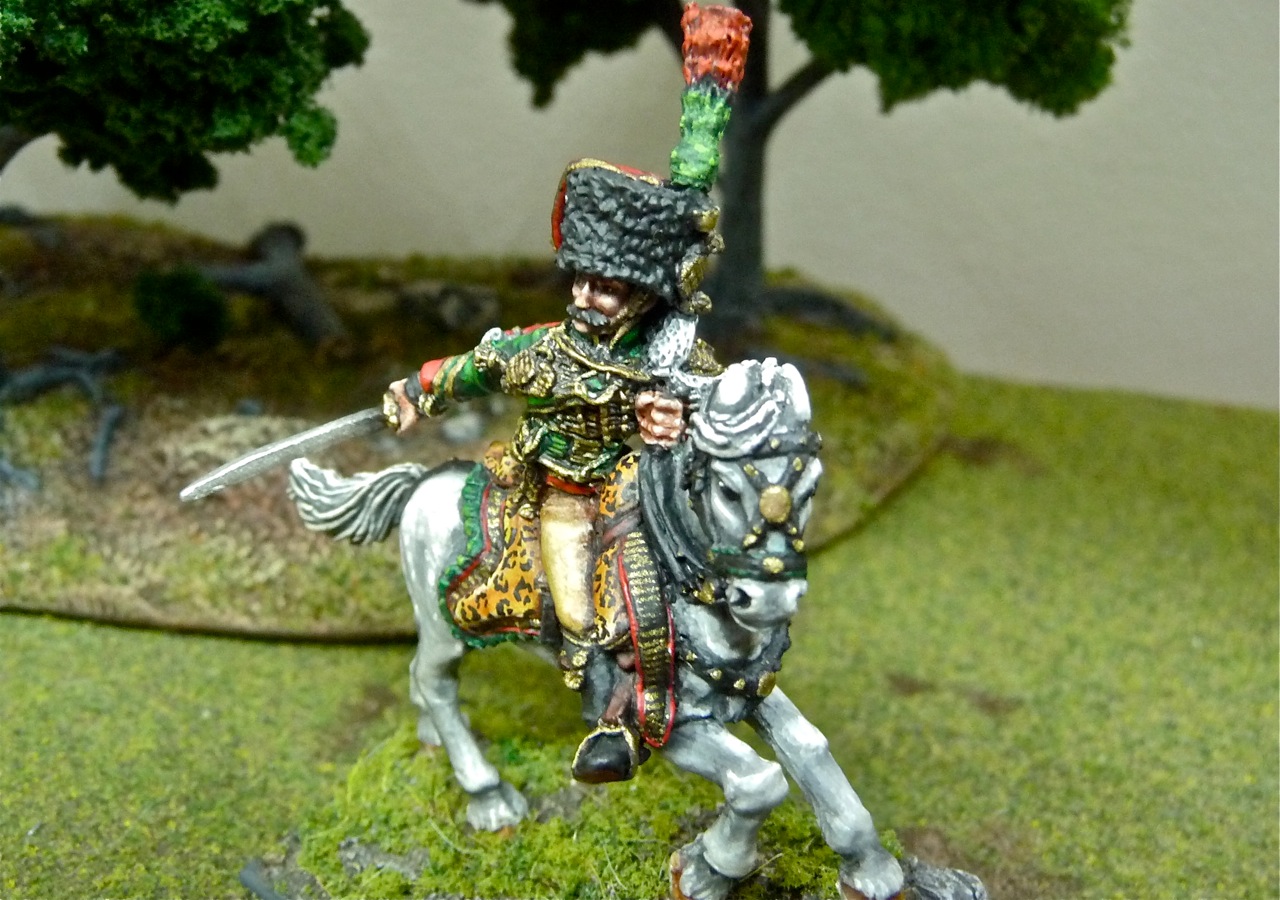
Whenever I think that my painting skills may be improving I pull this old chestnut out from my display cabinet to get a reality check. This Chasseur a Cheval officer of the Imperial Guard was given to me as a gift about 15 years ago by my friend Brian Homenick (of Vaubanner Graphics), who is, as you can plainly see, a phenomenal painter. 


This is a venerable 28mm Wargames Foundry casting, sculpted by Alan Perry, which still holds its own amongst the best out there today. The pose is taken from the famous painting by Theodore Gericault titled "The Charging Chasseur" which was first exhibited in 1812 and can be viewed today at the Louvre (see above).


I remember Brian giving me the model in an almost nonchalant manner, just a slight smile and a shrug. Almost like, "I thought I'd give this one a whirl, and well, here you go." Awesome.


A few years ago, when I was living in Ontario, I met up with another good friend, Dallas (another venerable member of the Fawcett Ave Conscripts), to check out a Games Workshop's 'Games Day' event in Toronto. It was pretty cool as the energy level from all the kids was completely off the hook, but the real reason I was excited to go was because the Perry twins were in attendance to show off their latest work for GW and visit with the geeks. I duly stood in line with what seemed to be a battalion of pimply teens and managed to chat with the both of them for a few minutes. During this time I pulled out a few of my favourite Napoleonic models of their design and asked them to sign the bases for me. Of course Brian's Chasseur was one of these and Alan Perry was kind enough to oblige. 


I remember we all thought it pretty funny being at an event which showcases EVERYTHING Warhammer and here we were gabbing on about Napoleonics. I came away completely stoked and I remember Sarah nodding and smiling indulgently as I described by field trip and the cool 'autographs' I received. Yep, complete nerdgasm.


Anyway, there you go. The Chasseur remains a prized gift and a constant source of inspiration. Thanks Brian!


Note: Brian also painted for me the complete set of Foundry's dismounted Napoleon, Marshals and staff (its the one with Napoleon seated with his boot on a drum). As you can imagine its a real treat and I'll post it up in the future.

Wednesday, November 9, 2011

1er Regiment de Carabiniers (early uniform) REDUX


The first group of these figures (ten, I think) originated from my earlier days in the hobby and I decided last spring that I wanted to enlarge and rebase them so they better aligned with the look and feel of our 'Big Battalion' games. So here is the regiment, fresh with replacements, (24 strong) ready to be deployed on the tabletop.


The early Carabinier uniform is one of my favorites of the period as, to me, it personifies both the elegance and power of the French heavy cavalry at that time. Sure, the later brass cuirass and crested helmet was very fashionable and quite swish but I think it lacked the understated grace of the long-tailed cutaway coat, white waistcoat and tall bearskin bonnet.


It is believed that the regiment retained a high proportion of aristocrats from the ancien regime which may have helped it maintain a greater level of professionalism during that early period when the French cavalry typically suffered from a lack of experienced officers (at this time the guillotine was very busy providing 'advancement opportunities' to meritorious NCOs and junior officers). 


An interesting anecdote from this early period is during 1800, when the 1st Carabiniers were billeted in the small German town of Eichstadt. The impoverished town was so strained under the burden of French taxes that it faced the prospect of having to sell its sacred vessels from the local church in order to raise sufficient funds.  On hearing of this situation the Carabinier officers first tried to get the debt reduced, and failing that, passed the hat amongst themselves in order to pay the debt from their own pockets. For years afterward, long after the French were considered to be the arch enemies to all Germans, the grateful town of Eichstadt celebrated an annual mass for the 1er Regiment de Carabiniers a Cheval.


A little known but dramatic action involving the Carabiniers occurred early in the 1809 campaign when they faced against their equivalent in the Austrian Cuirassiers in a moonlit melee near the village of Alt Egolfsheim.  The Austrians were covering the retreat of their infantry after the Battle of Eckmuhl to which the French were vigorously pursuing. The Austrian Gottensheim Regiment of Cuirassiers led the charge and were met with a short range volley of carbine fire from the 1er Regiment de Carabiniers, who then slung their firearms, drew swords and charged. The combination of their numbers, training and superior mounts allowed the French  to prevail. (John Elting writes that the quality of the enormous Flemish and Norman horses was telling against the largely untrained remounts of the Austrian troopers)

The French heavy cavalry was used ruthlessly by Napoleon during the vicious battles of Aspern-Essling and Wagram. The cuirassiers and Carabiniers were often sacrificed to fill gaps or to buy time for the infantry to redeploy.


After the shocking losses they suffered during the 1809 campaign it was decided to equip the Carabiniers conforming with the regulations of the rest of the heavy cavalry arm, that is with helmets and full cuirass. With typical Gallic elan the Carabinier troopers received the news of them being issued armour rather poorly, thinking it to be an insult to their honour and courage and it took no small amount of convincing to have them surrender their beloved bearskins and long coats.


These are relatively older Foundry castings but they are still amongst the best depicting this early Carabinier uniform. I expect that either Victrix or the Perry's (if not both) will come out with a new rendition in the years to come.


Above is a small conversion to a cavalry casualty figure depicting a Carabinier trooper who has been shot from his horse which is gamely galloping forward with the charge.


As these larger cavalry units can be a bit of a nuisance to move around the table I decided to place them into movement trays that Sylvain kindly mocked-up for me in card. We decided to break them over two sections to facilitate both the extended line and supported line formations which were common doctrine at the time.


I think I have enough castings in 'the lead stocks' to do the 2nd Regiment but I'm afraid that'll be down the road as I need to get another Dragoon regiment done to fill out a proper brigade - but more on that later!


(Information from John Elting's Swords Around A Throne, David Johnson's Napoleon's Cavalry and its Leaders, James Arnold's Crisis on the Danube and Napoleon: His Life, His Wars, His World vol. 10. Illustration buy Angus McBride.)

Wednesday, October 26, 2011

16th Regiment of Line in 1806 Regulation White Uniform

'
The new lads from the 2nd battalion in all their off-white glory. A mounted officer behind the rear ranks is happily making the mens life a misery ...

For those who may have been following this blog last winter this unit has been languishing at the rear of my painting desk for several months now so I thought it high time to get it done and ready for action.

The 16th Regiment, deployed in line, ready for action.
These three units depict the 1st, 2nd and 3rd battalions of the 16th Regiment of the Line. From 1806-1807, due to a lack of indigo dye, Napoleon issued a new uniform regulation that would see his line infantry begin a conversion from its standard blue uniforms to new ones in white. He initially chose 19 regiments in order to determine how they would hold-up in the field. It is not known exactly how many of these 19 regiments were actually issued the uniform but it is confirmed that there were at least eight regiments dressed in white by the end of 1806.


In 1806 the 16th was issued the white uniform with blue facings and turnbacks. John Elting mentions that this uniform was very sharp, being a hit in Paris, but (as could well be imagined) very difficult to keep clean in the field. I also chose the 16th as it saw heavy action in one of my favorite Napoleonic battles, Aspern-Essling. At that battle they were under the command of Molitor and were in desperate close-combat contesting the town of Aspern.


Napoleon ultimately changed his mind on the white uniforms. Some say it was because he was appalled at how the blood stood out on them after the battle of Eylau, but I think this is a little sensationalist as Bonaparte was a man not easily moved by the sight of carnage. I think it was merely due to the fact that French producers found a way to source blue dye to maintain the established uniform. Nonetheless the white uniform was popular amongst those regiments that received it and it was not until late 1809 that the last battalions were (begrudgingly) converted back to blue.


I decided to keep the third battalion in greatcoats to indicate their more conscripted status (something I will probably continue to do with all the higher numbered battalions in my regiments). A portion of the figures from these three units I bought in an Ebay auction. Nonetheless they were a little rough around the edges, in need of a bit of 'tweaking' and fleshing out to get ready for the table (shipment repairs, highlighting, washes, rebasing, drybrushing, etc). I also added new NCOs, colour party members and mounted commanders to all the battalions to tart them up a bit more. All of the flags, as usual, are from the indispensable Flag Dude.